

One of the very best episodes of the sitcom New Girl comes in the fourth season when the lovably frenetic character Schmidt attempts to win a sponge company account at his marketing firm by pitching the product to men. Hijinx ensues when his affably idiotic friends derail his plans. But the core thesis of the episode’s plot — broadening the target market — is a valuable lesson. For Hollywood, it’s a prescriptive formula after studios left gobs of money on the table this summer by failing to activate entire swaths of key demographics.
Let’s start with the important numbers before exploring how to right the ship.
From May through Labor Day, the domestic box office collected $3.67 billion, slightly below last summer (-0.2%). That’s ahead of 2022’s $3.4 billion, but behind 2023’s $4.09 billion and the pre-pandemic norm of roughly $4 billion. A strong May led by a record Memorial Day Weekend (Lilo & Stitch, Mission: Impossible—The Final Reckoning) gave way to weaker June, July and August totals. Family films continue to perform well, while the three big July blockbusters all cannibalized each other chasing the same Male 25-45 demo. As of this writing, 2025’s box office is still around 4% ahead of last year. But with a soft September expected, the year will almost assuredly finish below the $10 billion-plus pre-pandemic norm yet again (unless Avatar: Fire & Ash and Zootopia 2 go absolutely nuclear).
The summer season’s volatility largely comes down to:
- Which titles did and didn’t get women into theaters
- Which studios programmed consistently for the most reliable audience demographics

Don’t Forget Female Audiences
Despite recent women-led hits (The Woman King, Everything Everywhere All At Once, Barbie, It Ends With Us, Moana 2, Inside Out 2, Wicked) female audiences remain underserved (shocker, we know). Hopeful blockbusters that capture a meaningful attention share here stand a better chance at success than those banking on an over-abundance of male ticket-buyers. Back to New Girl: Schmidt wanted to sell sponges to a greater variety of customers. Hollywood should too.
Jurassic World: Rebirth grossed $338 million domestically on a $92 million three-day opening. This equates to a 3.68x domestic multiplier, a useful metric that helps us understand how leggy or frontloaded the performance was (3.0x and above is generally the goal). Interest (61%), Theatrical Intent (53%) and Willingness to Pay a Fee (61%) among women in the week of release were all strong. The dino sequel, headlined by Scarlett Johansson, moved beyond its core demo and attracted women as well as kids/families.
Contrast that with Superman. The reboot grossed slightly more domestically ($352 million) but with a weaker 2.81x domestic multiplier. Why? Its softer female scores—Interest (47%), Theatrical Intent (43%) and Willingness to Pay (52%)—capped its upside. The film is a no doubt about it hit, but relied heavily on men over 35 to get there.

Despite comparable Awareness and Theatrical Intent scores among all audiences, Rebirth converted interest among those aware more effectively (69% vs 63%). What does this mean in practical terms? Even movies with similar topline tracking—and every percentage point can represent a not insignificant amount of potential box office revenue—can diverge depending on their ability to convert non-core quadrants. It’s sort of like how I’ve aged out of trick-or-treating but will definitely buy a bag full of bite sized Hershey’s Cookies ‘n Cream bars come Halloween. I’m not the target customer, but I’m still contributing to sales (and my waistline).
Solid female turnout powered over performances for the live-action How to Train Your Dragon (WTP scores at 54%) and Final Destination: Bloodline (49%). Horror film Weapons, which is proving particularly leggy, saw higher Interest among women than men and equal Theatrical Intent scores in the week of release, further showing how horror is a more evenly gendered genre than most.
Studios often assume blockbusters with strong intellectual property are inherently four quadrant—appealing to men and women, old and young. That may have been true in the gravy days of the 2010s when the domestic box office surpassed $11 billion in five straight years. But the data shows that most major films lean heavily on the male over/under 35 audience while under-engaging women 35 and younger. Movies that expand beyond their core demos tend to post stronger, steadier results.
Cultural Audience Demographic Gaps
Looking at the five highest-grossing summer movies (Lilo & Stitch, Superman, Rebirth, The Fantastic Four: First Steps and How to Train Your Dragon) reveals another pattern: diverse audiences are the more consistent moviegoers.
Interest, Theatrical Intent and Willingness to Pay a Fee scores were consistently higher among Black and Hispanic/Latino audiences versus White audiences across all five films, even though White audiences typically showed higher awareness. This means marketing campaigns are converting Black and Hispanic/Latino audiences into ticket buyers at a higher rate, though these demos also remain underserved overall. It also helps to show how studios need to tailor awareness and persuasion campaigns to different audiences.
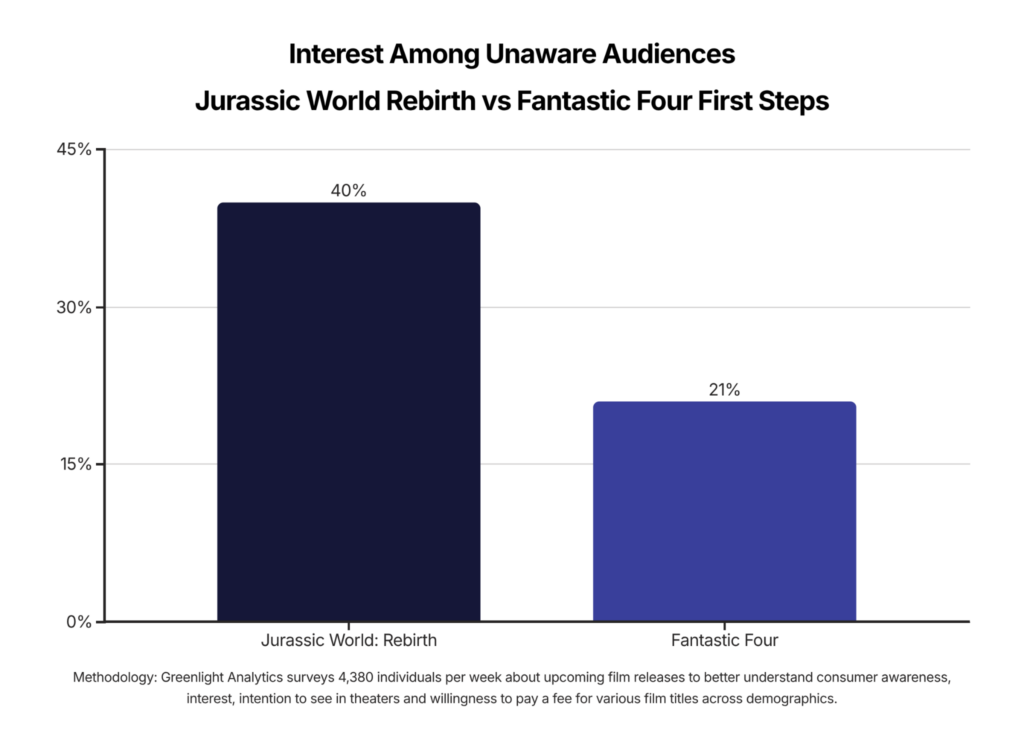
One example of this split can be seen with Rebirth and Fantastic Four, which entered their release weeks with comparable Awareness and Theatrical Intent scores. But Rebirth (40%) outperformed Fantastic Four (21%) in interest among all audiences unaware of the films. Translation: Rebirth elicited stronger “walk-up” ticket sales (families, women, diverse audiences) outside of its primary bubble (dudes who love dino mayhem). Fantastic Four, meanwhile, was more limited to those already engaged (MCU die-hards), partially explaining its weaker 2.26x multiplier.
It isn’t raw awareness that determines the winners and losers in the box office battle, but how many audience segments a given title can activate.
Industry Implications
Despite matches in overall metrics, especially in general awareness and interest, the “winners” were the ones who successfully engaged in broader appeal and activation beyond the target demo. Many factors contribute to successfully boosting turnout: superhero fatigue vs. general affinity for dinosaurs vs. the mystery box intrigue of Weapons, etc.. But it’s become clear that even hopeful four-quadrant films are struggling with targeting issues, wasting precious marketing dollars in the process. Different audience demos need different messaging. Hollywood must stop treating women, Black, and Hispanic/Latino audiences as “found money.” They are the differentiators between “meh” and “massive” at the box office.
Summer 2025 under-performed not because the audience didn’t exist, but because studios failed to broaden the appeal of major titles. Moving forward, success requires engineering four-quadrant appeal intentionally:
- Program consistently for non-White audiences, who have proven to be among the steadiest moviegoers.
- Develop films and design marketing campaigns with female turnout in mind, particularly among the under 35 crowd.
- Stop relying on outdated norms (such as built-in four-quadrant appeal for major IP and over-relying on raw awareness) from a theatrical industry that no longer exists.
Hollywood doesn’t need more sponges—it needs to sell them to the whole household.
 © 2024 The Quorum, LLC, All Rights Reserved.