
Theodore Roosevelt was absolutely right when he said that comparison is the thief of joy. He likely never imagined that his philosophy on personal growth and contentment would be applied to moviemaking more than a century after his death, but here we are! Roosevelt’s words ring particularly true in the world of theatrical film, where comparisons without proper context dash any hopes of realistic expectations. In doing so, they set the stage for negative narratives to take hold, coloring perception and distorting reality. Movie X failed to earn as much as Movie Y at the box office and therefore must be a disastrous flop. Give me a break.
Clinging to institutional muscle memory to analyze box office performance against a rigid set of unchanging comps has left no room for data flexibility. Blind faith and gut-feel comparisons no longer suffice. Studios and producers deserve a better model—one built from transparent inputs, demographic modeling, and live momentum signals that capture what’s really going on. That’s how we should be driving the public discourse. In doing so, we give each title a fair shake while ensuring marketing budgets aren’t being wasted.
The “Comp-Only” Box Office Trap
Hollywood’s over-reliance on first-glance comparisons creates an inaccurate feedback loop that recent releases have exposed. Identifying films with similar genres, budgets, and release windows helps provide early long-range box office comparisons. But problems arise when those early comps are set in stone despite what real-time data feedback suggests. Even if the No. 1 overall NBA pick Cooper Flagg scores more points in his upcoming rookie debut than LeBron James did in his, that doesn’t mean he’s the next LeBron.
Superman is a perfect recent example. Early industry-wide tracking for the film projected various openings with ceilings that exceeded $145 million-plus. That generous runway was largely due to the use of Deadpool & Wolverine, which collected more than $200 million in its July debut last year, as a primary comp. Yet as pre-release tracking continued, it became clear to those paying attention that the two films weren’t all that comparable. (As a general rule of thumb, sequels fare better than reboots/remakes).
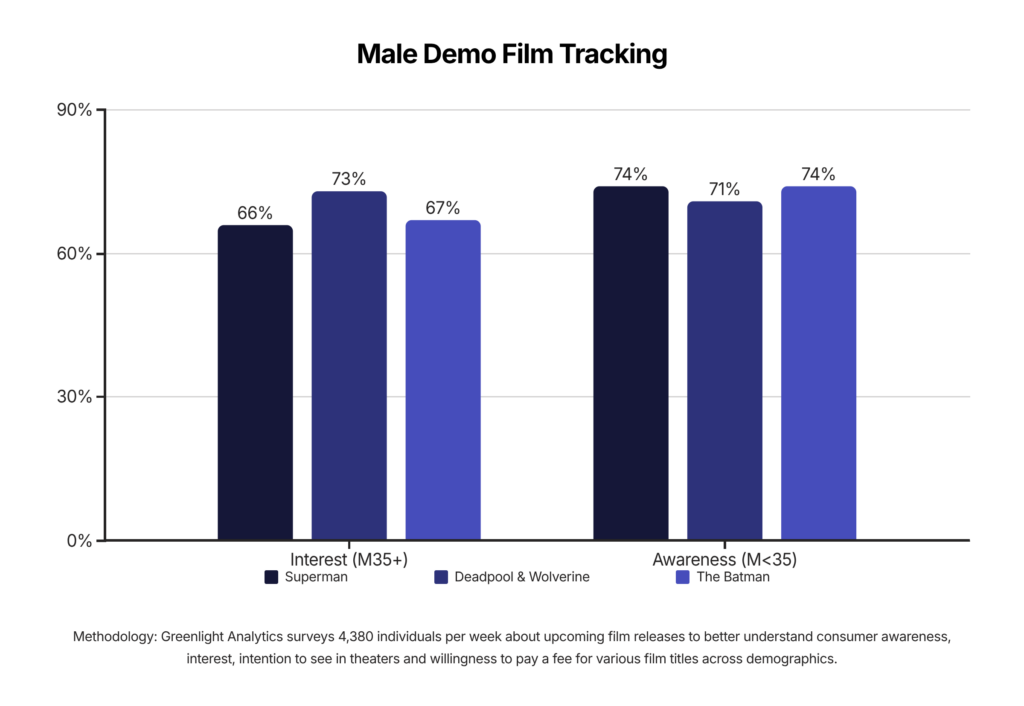
Theatrical intent—or those that plan to see a film in theaters—was consistently around 20 points higher for Deadpool than Superman when it came to male moviegoers under 35. This was a clear indicator that the former was considered a must-see event, while the latter didn’t quite generate the same urgency. Superman also trailed Deadpool by 15-20 points in Willingness to Pay a Fee (either a theatrical ticket or VOD transaction) scores across core demos throughout much of the pre-release campaign.
Early on, Greenlight Analytics substituted The Batman for Deadpool & Wolverine among Superman’s comps thanks to better demographic and thematic overlap in tracking. Though Superman’s Intent Conversion score (dividing theatrical intent by awareness) of .65 was below both The Batman (.90) and Deadpool (.89), its Monetization Potential score (dividing willingness to pay by interest) of 1.0 was nearly identical to its superhero siblings (1.1). With that switch, our model projected an opening weekend for the Man of Steel in the $111 million-$130 million range 42 days prior to release. The ultimate result six weeks later? A $125 million debut. Using The Batman as a better thematic and demographic match aligned long-range projections closer to reality.
Comp selection determines forecast success, which in turn sets the table for public expectations, which then shapes the ultimate narrative and perception. (Exhausting, we know). But most models don’t make actionable swaps based on real-time inputs such as gender, age, demographics, interest, and other factors. That’s how you end up with all corners of Film Twitter at each other’s throats because no one can agree on what constitutes success or failure anymore.
Layered Approach to Audience Activation
While proper comp selection is crucial, true forecasting accuracy requires going deeper than surface-level comparisons. A key focus should be capitalizing on the audience opportunity through multiple segments and demographics: Awareness, Interest, Theatrical Intent, and Willingness to Pay a Fee. This approach enables you to accurately project the floor and ceiling of your title’s theatrical earning power based on how effectively a marketing campaign activates various audience demos. Did that $8 million Super Bowl ad really move the needle?
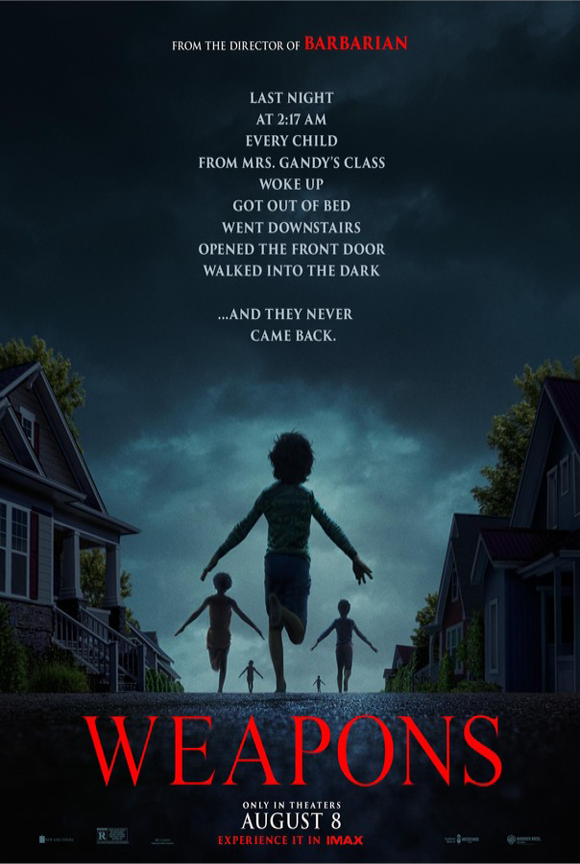
The ability to detect these shifts in real-time can provide Paul Atreides-level glimpses into the future. In the weeks leading up to the release of Zach Cregger’s Weapons, there was significant growth across all four key metrics for audiences under 35. This put the movie well ahead of Cregger’s debut film, Barbarian, while pushing interest metrics for the under 35 crowd to match our ceiling comp (Jordan Peele’s Nope). It was particularly encouraging to see late-campaign movement as the bulk of a film’s marketing spend is reserved for this window, though often only results in awareness spikes without conversion.
But at the same time, awareness and theatrical interest among the 35+ crowd did not enjoy notable bumps in the final three weeks, hence our $36M ceiling for its pre-release debut projection. But the writing was on the wall for an over-performance. Weapons tracked well in metrics such as “Heat” (the percentage of respondents who rate their interest at the highest possible level) and “PLF” (the percentage who intend to see the film in a Premium Large Format theater), which help identify the most passionate and commercially valuable segment of a potential audience.

This leads to another key question that traditional forecasting often overlooks: should we treat gender-specific interest as equivalent to overall interest? (Spoiler: no).
Freakier Friday’s awareness among women in the week of release (83%) was virtually unrivaled outside of Barbie. Yet its polarizing interest gap between women (61%) and men (44%) was a clear indicator that it was never going to match Barbie’s $162 million opening (few films do). A better summer-level comp we found was It Ends With Us, which opened to a more realistic $50 million. That’s how we ended up with a week-of projection of $30 million versus its $29 million debut. Pretty much right on the money.

Awareness for both Weapons (+27 percentage points) and Freakier Friday (+ 28 percentage points) climbed significantly from April to their August 8 openings. Yet in the same timeframe, lifts in Interest (+14, +13), Theatrical Intent (+ 10, +8) and Willingness to Pay (+9, +7) did not match. Why not? Because the marketing did not always convert awareness into action, especially among large swaths of key demos. Both films enjoyed successful openings, but the underlying data suggests Freakier Friday might have left some money on the table.
Comp + Demo = Box Office Forecast Differentiator
The most impactful projections come alive when demographic insights are paired with proper comp selection. Let’s use Universal’s The Bad Guys 2 vs its original The Bad Guys as an example.
While many forecasters used The Bad Guys’ $23.9 million debut in 2022 to forecast $25 million–$35 million-plus for the sequel, Greenlight Analytics landed on a more conservative $20–28M range—ultimately closer to its $22.2M debut. Why were we more bearish than others? The original benefited from stronger pre-release signals among parents and older female demos. Specifically, women under and over 35 posted at least a 40% theatrical intent score at the time of release. By contrast, The Bad Guys 2 saw a clear drop in intent from those same cohorts. While scores among men under 35 held relatively steady, the female audience intent notably softened despite similar interest levels.
By the week of its release, the sequel had only mustered a .65 Intent Conversion score, behind animated successes such as The Bad Guys (.88), Dog Man (.78), Elemental (.69) and others. This implies that the film struggled to entice moviegoers that were aware of it to actually buy a ticket heading into opening weekend. (Note: While a higher Intent Conversion score reflects stronger conversion among those aware of a film, it does not automatically translate into a larger box office opening. Lower awareness films, such as Migration, can post high conversion rates but still open smaller than widely known titles like Kung Fu Panda 4).

This gap suggests that while The Bad Guys 2 retained core fans of the original, it didn’t expand beyond them in the way the original had garnered broader interest and intent, putting a cap on its earnings potential. Other forecasters may have relied too heavily on genre comps without adjusting for demo shifts. But an audience-first approach helped avoid that trap.
All the examples present in this essay demonstrate a consistent pattern: when demographic insights refine comp selection, forecasting accuracy improves and money can be spent more efficiently. This underscores an important shift needed in how the industry approaches box office prediction.
Conclusion
Comps will always be part of box office forecasting—and they should be! They help us form baseline expectations. But using comps alone is akin to trying to hit a bullseye while drunk. Context, demographics, signal velocity, and flexibility are what really make the difference over time.
Studios need greater confidence in what to greenlight, how to time marketing, which audiences are being activated and how to shift tactics to broaden reach. On top of that, they also need to do this at a fraction of the cost of pre-pandemic budgets. Remaining open to swapping in new comp sets based on real-time feedback and layering in an understanding of specific audience conversion is key to aiming more efficiently and accurately today. When in doubt, listen to Roosevelt’s advice by expanding the framework for projecting success and shaping the discourse.
 © 2024 The Quorum, LLC, All Rights Reserved.